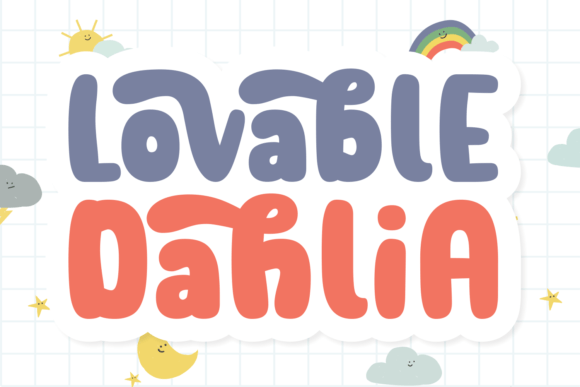
Lovable Dahlia Font: A Cute & Chubby Display Typeface for Digital Branding
Lovable Dahlia Font for Hero Sections and Landing Page Headlines
Lovable Dahlia Font is a cute and chubby display font built to command attention—not just in print, but in live web environments. As a web designer, I reach for Lovable Dahlia Font when the hero section needs warmth, charm, and immediate emotional resonance. Its rounded terminals, generous x-height, and soft curves make it highly legible at large sizes—even on mobile viewports—while maintaining its playful personality. Unlike overly delicate script fonts or rigid geometric displays, Lovable Dahlia Font balances visual weight with approachability, making it ideal for SaaS landing pages, creative agency headers, or boutique product launches where tone matters as much as conversion.
Lovable Dahlia Font for Online Store Banners and E-Commerce Promotions
When designing banners for online stores—especially those selling handmade goods, children’s products, wellness kits, or lifestyle brands—Lovable Dahlia Font delivers instant tonal alignment. As a display font, it thrives in high-contrast settings: think white text over pastel gradients, soft shadows on product mockups, or animated SVG headlines in Shopify sections. Its chubbiness ensures strong readability at smaller banner heights (as low as 48px on desktop), and its consistent stroke width prevents pixelation on retina screens. For best results, use Lovable Dahlia Font exclusively for short promotional phrases (“Spring Sale Starts Now”, “Handmade With Love”)—never body copy—and pair it with a clean sans serif like Inter or Manrope for supporting text.
Lovable Dahlia Font for Creative Portfolios and Personal Brand Websites
Lovable Dahlia Font isn’t just decorative—it’s a strategic branding tool for designers, illustrators, coaches, and creative entrepreneurs building personal websites. As a display font, it signals personality before a single word is read. On portfolio sites, I use Lovable Dahlia Font for project titles, service headers (“Brand Strategy”, “Illustration & Design”), and even subtle hover effects on navigation links (with fallback to system fonts). Its inherent friendliness lowers perceived friction, encouraging visitors to explore deeper. Just be mindful of licensing: ensure your Lovable Dahlia Font license covers web embedding via @font-face or variable font delivery through platforms like Adobe Fonts or self-hosted CSS.
Lovable Dahlia Font for Blog Headers and Newsletter Subject Lines
Blog headers and email subject lines are micro-moments—0.8 seconds to earn a click. Lovable Dahlia Font excels here because its chubby proportions increase letter recognition speed at glance. As a display font, it works best for H1s and H2s in editorial layouts, especially when paired with a neutral serif (like Playfair Display) or humanist sans (like Open Sans) for body text. For newsletters, export Lovable Dahlia Font as an embedded image header only if your ESP doesn’t support custom webfonts—otherwise, test rendering across Gmail, Apple Mail, and Outlook first. Avoid using it below 24px in email clients; its charm fades fast in tiny sizes.
Lovable Dahlia Font for Mobile App Screens and UI Microcopy
While Lovable Dahlia Font isn’t suited for long-form app text, it shines in targeted UI moments: welcome screens, empty-state illustrations (“You haven’t added anything yet! 🌸”), onboarding step labels, or celebratory modals (“Yay! Your order is confirmed!”). As a display font, it adds emotional punctuation without sacrificing clarity—provided you limit usage to short, high-impact phrases. Always test contrast against both light and dark mode backgrounds: its rounded forms hold up well on #F9F7F5 but need at least 4.5:1 contrast ratio on charcoal tones. Bonus tip: Use font-weight fallbacks—many display fonts like Lovable Dahlia Font include only one weight, so plan spacing and line-height carefully in responsive breakpoints.
Lovable Dahlia Font for Social Media Graphics and Digital Ads
Social feeds move fast. Lovable Dahlia Font cuts through noise by leveraging shape-based recognition—its chubby letterforms register faster than thin or condensed alternatives. As a display font, it’s perfect for Instagram carousels, Pinterest pins, and Facebook ad banners where you have under three seconds to communicate vibe + value. Use it for primary headlines only; never for captions or CTAs that require scanning. Export graphics at 2x resolution and embed Lovable Dahlia Font as vector outlines (not live text) when uploading to platforms that don’t support custom type. And remember: while Lovable Dahlia Font conveys creativity and care, it’s not for finance, legal, or enterprise tech brands unless intentionally subverting expectations.
Lovable Dahlia Font for Brand Identity Kits and Digital Templates
If you design brand kits, Notion templates, Canva layouts, or Figma UI libraries, Lovable Dahlia Font belongs in your core assets folder. As a display font, it adds instant cohesion to mood boards, style tiles, and presentation decks—especially for clients in education, parenting, wellness, or creative services. Its cuteness reads as intentional, not childish, when balanced with ample whitespace and restrained color palettes. Check file formats: prioritize .woff2 for web use, .otf for design apps, and verify multilingual support if serving global audiences. Most importantly—verify commercial licensing covers template resale, client deliverables, and SaaS integrations. A single Lovable Dahlia Font license may not cover unlimited redistribution.
Lovable Dahlia Font for Button Labels and Conversion-Focused CTAs
Yes—you *can* use Lovable Dahlia Font for buttons, but only under strict conditions. As a display font, it works for primary CTAs in emotionally driven funnels: “Get My Free Guide”, “Join the Circle”, “Start Your Journey”. Never use it for secondary actions (“Learn More”, “Skip”) or form fields. Keep button height ≥ 44px on mobile, add 8–12px letter-spacing for breathing room, and always test tap targets. Pair with a robust sans serif for input labels and helper text. And crucially: confirm your Lovable Dahlia Font license permits use in interactive elements—some display fonts restrict dynamic rendering in JavaScript-heavy interfaces.